



Rigid Inclusions Solutions

Need to reinforce poor soils? Build on clay, silt, and peat (without breaking the bank).

ICOP installs rigid inclusions by drilling through or displacing highly compressible, sensitive soils, then filling the resulting space with concrete or grouted aggregate columns. These stiff elements transfer loads through weaker soils into more competent layers. Bypass existing foundations and utilities, safely displace contaminated material, and quickly reach a denser bearing stratum.

Applications

Using Rigid Inclusions

We’ve partnered with Geopier® to provide proven ground improvement services and a suite of rigid inclusions systems — all backed by rigorous third-party testing.

Improve Low-Quality Soils

Overcome softer, more compressible soil conditions.

Control Settlement

Mitigate unacceptable total and differential settlement.

Support Heavy Loads

Get economical, high-strength structural support.

Value Added

Benefits of Rigid Inclusions

Our technologies address site-specific constraints such as vibration, contamination, limited access, undocumented fills, slope instability, and more.
Vibration-Free Installation
Less Concrete & Steel
Schedule Acceleration
Drill or Displace Soils
Spread Footings
Multiple Diameters
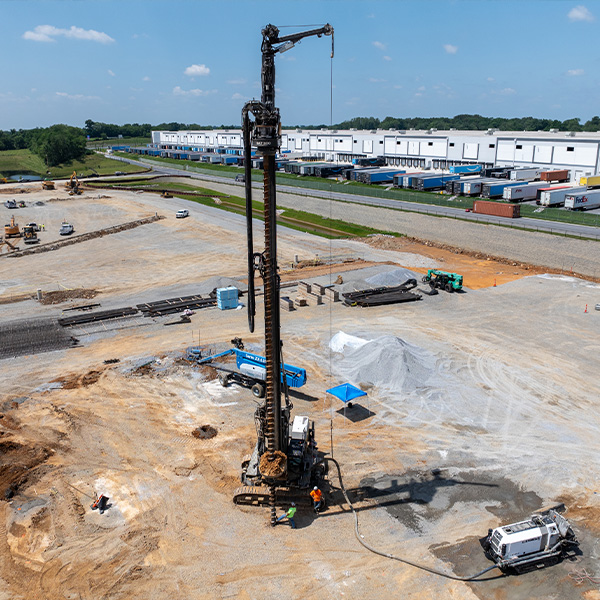
Drilling rig at construction site with workers and warehouses.

What We Deliver

A Site-Specific Foundation Plan

When an aggregate pier won’t get you where you need to be, don’t jump straight to deep foundations.

ICOP’s in-house engineers weigh all factors — from soil conditions to nearby structures to project specifications — to provide you with a high bearing capacity and a more economical foundation design for a highly loaded building.

Rigid Inclusions

Geopier® & 
In-House Solutions

  • Geopier® Grouted Concrete Columns

    GeoConcrete® Columns (GCCs) consist of two components: a dense base bulb and an extruded column, both of which are made of concrete. In this rigid inclusion, the concrete is placed in a closed system for improved quality control. Because ICOP uses a displacement mandrel, there is no need to haul off unsuitable or contaminated materials.

    View White Paper
  • Geopier® Cement-Treated Aggregate Piers

    The CTAGP system offers particularly high structural strength when bearing on rock and allows for footings to be designed with higher bearing pressures than other rigid inclusions. They’re installed with the same “drill and fill” method as the GP3® pier system, with one exception: the inclusion of dry cement for added strength.

    View White Paper
  • Ductile Iron Piles

    Ductile iron piles are made of interlocking iron pipes. We install them in segments using small equipment, which makes them an option for sites with difficult access conditions. Because ductile iron pile installation relies on displacement and generates very little vibration, we consider it for projects with contaminated soil layers or nearby structures and utilities.

    View White Paper
  • Continuous Auger-Cast Rigid Inclusions

    To create these rigid inclusions, our construction team advances a continuous flight augur to the desired depth. As it is removed, we pump concrete down into the borehole. The end result is a continuous concrete support column.

  • Full Displacement Columns

    To install these columns, we use a specialty auger that displaces soil instead of advancing it to the surface. Once it reaches the appropriate depth, our crews pump in grout while slowly removing the auger, leaving behind a rigid inclusion capable of withstanding heavy loads.

logomark

Value Engineered Structural Support